The breakthrough was not merely removing a wire. It was designing a network that could locate, serve and transfer a moving subscriber.
Mobile before the mobile phone
Radio communication had long enabled ships, emergency services and vehicles to communicate without a physical line. Public mobile telephone services developed around vehicle-mounted equipment, where power, antenna size and weight were easier to accommodate. A call could connect into the ordinary telephone network, but capacity was severely constrained.
Large coverage areas used a small number of radio channels. When a channel was occupied, another caller could not use it in the same service area. Equipment and service were expensive, and operation could involve manual assistance. Mobility existed, but not yet at mass scale.
Divide territory, reuse spectrum
A cellular system divides a service region into smaller areas served by base stations. Frequencies can be reused in sufficiently separated cells, multiplying capacity without requiring a unique channel for every subscriber across an entire city. Network planning manages interference, cell size and expected demand.
The concept developed over decades alongside switching technology, radio engineering, regulation and spectrum allocation. A diagram of neat hexagons is a planning abstraction; real cells overlap and respond to terrain, buildings, antenna patterns and load.
Keep the call while moving
A fixed telephone is associated with one physical line. A mobile network must know roughly where a device is registered so incoming calls can be delivered. During an active call, it measures or infers when service should move from one base station to another. This handoff is one of cellular telephony's defining operations.
Mobility therefore joins radio and switching. The handset negotiates with nearby infrastructure, while network databases and controllers coordinate identity, location, authentication and route. The visible antenna is only an edge of the system.
The handheld demonstration and product
Motorola engineer Martin Cooper is closely associated with a public handheld cellular telephone call in 1973. That event demonstrated a direction; it was not yet a widely available consumer product. Regulatory approval, network deployment, battery engineering and manufacturing still stood between prototype and service.
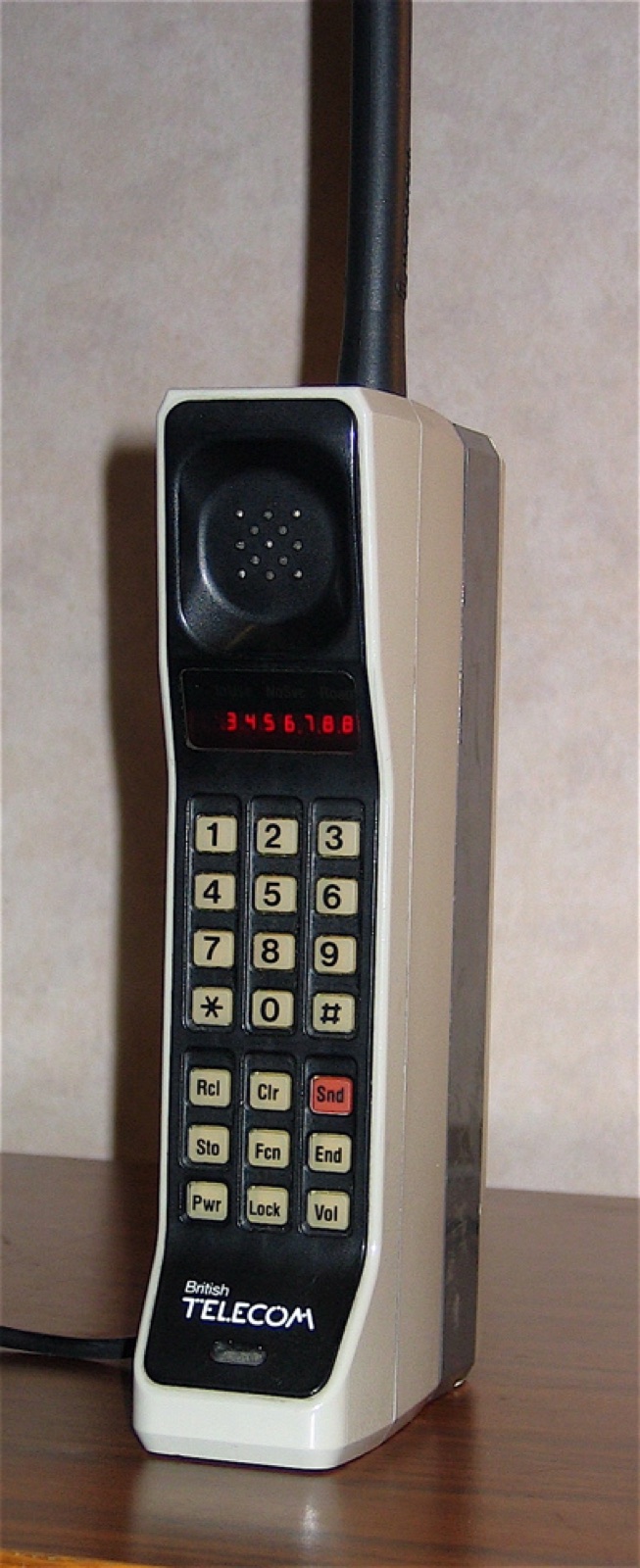
The Motorola DynaTAC 8000X became a prominent early commercial handheld in the 1980s. By current standards it was large, costly and limited in talk time, but it relocated the telephone from vehicle to person. Its form advertised a new social possibility: a number could reach someone in motion.
From analogue voice to digital services
First-generation cellular systems were analogue and differed among regions. Second-generation systems digitised voice and introduced standards including GSM, improving capacity and enabling services such as SMS. Later generations made packet data increasingly central, eventually turning voice into one service among many on an internet-oriented device.
Generation labels simplify a messy transition. Networks overlap, standards evolve within a generation, and commercial branding may stretch technical meaning. The durable historical shift is clearer: cellular telephony became a general mobile data infrastructure.