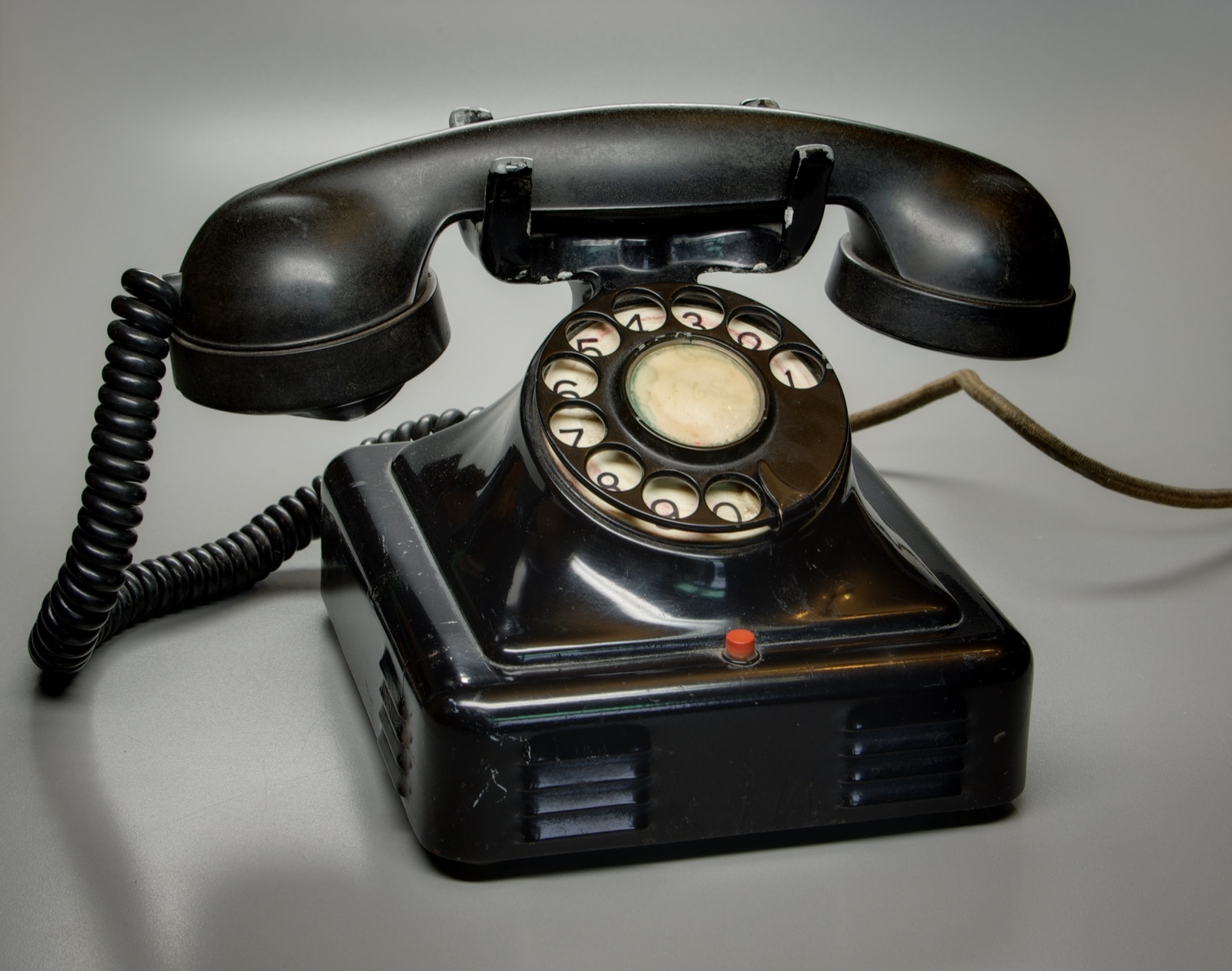
The dial did not merely select a contact. It generated timed interruptions that an exchange could count.
A finger wheel controls machinery
Rotary dialling translated a chosen digit into a sequence of electrical pulses. The user turned the finger wheel to a stop and released it; a governor controlled the return while contacts interrupted the loop. The exchange counted these interruptions and moved selectors accordingly. Zero typically produced ten pulses.
This explains the physical tempo of dialling. A high digit took longer to return, and a mistake often meant beginning again. The interface made the routing request tangible: the sound and movement were consequences of signalling, not decorative feedback.
The consolidated desk set
Early candlestick telephones separated the fixed transmitter from a receiver held to the ear. Later desk sets integrated transmitter and receiver into one handset resting on a cradle. Lifting the handset signalled off-hook status; replacing it released the line. The bell, dial and electrical components moved into a single robust body.
Design differed among countries and manufacturers, but the broad arrangement became instantly legible. Weight kept the telephone stable while dialling, plastics enabled new forms and colours, and standardized connectors eventually made placement more flexible.
A shared place and shared etiquette
A fixed telephone belonged to an address more than to an individual. It might sit in a hallway, living room or office where conversations were audible and access was negotiated. Families memorised numbers, kept paper directories and planned around the possibility that the person wanted might not be beside the instrument.
Calling involved uncertainty. There was no personal presence indicator, stored message thread or guarantee of privacy. Etiquette grew around when to call, how long to occupy the line and who answered for the household.
Touch-tone and electronic exchange
Push-button sets using dual-tone multi-frequency signalling offered faster input and supported new automated services. Electronic exchanges no longer required pulse dialling in the same way, although compatibility often persisted during transition. Cordless home phones later separated the handset from the wall socket within a limited local radio range.
The rotary telephone declined as a current interface but survived culturally because its mechanism is visible. It lets us hear a number being turned into a network command—an operation modern touchscreens conceal.