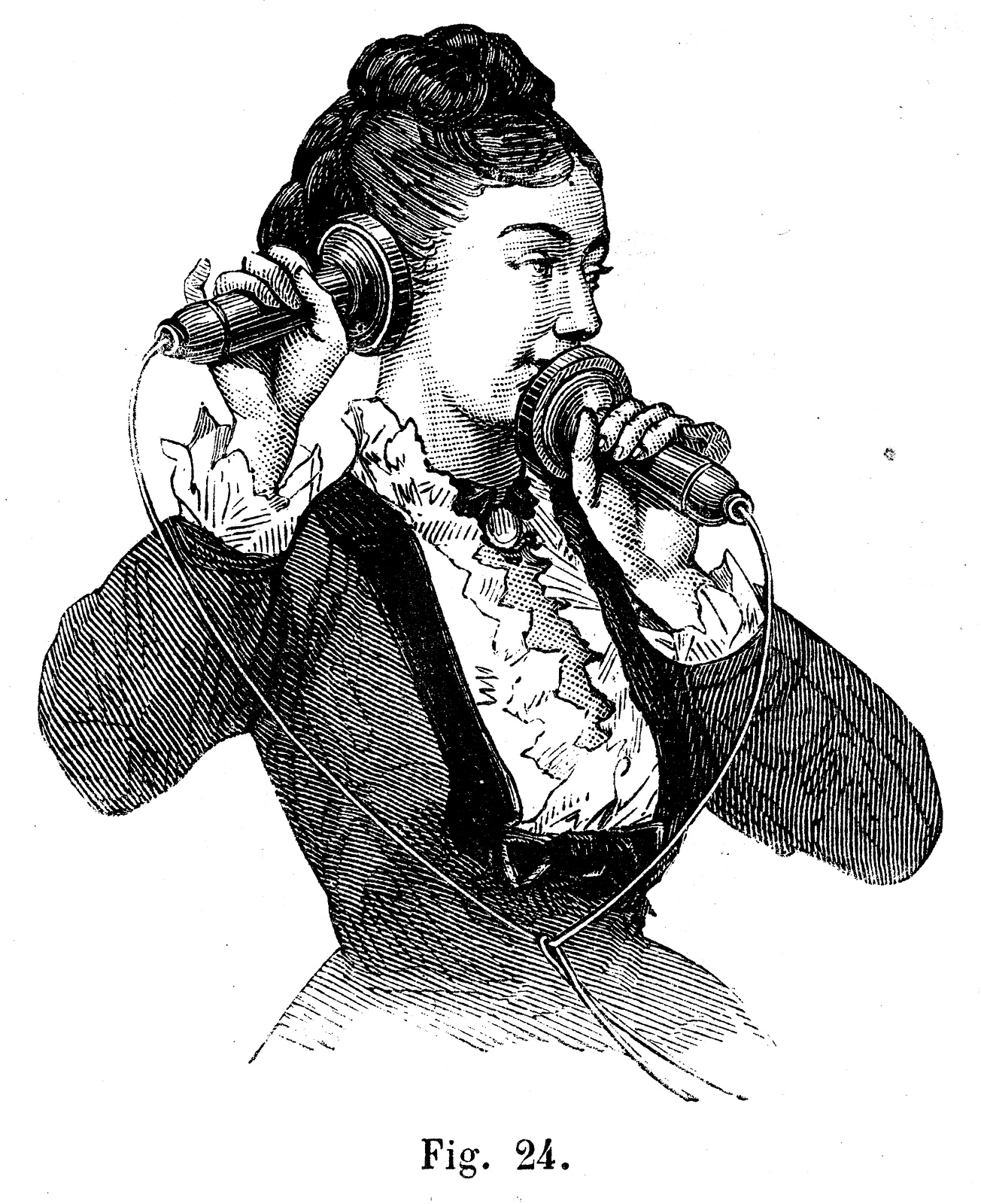
A patent marks a legal claim; a useful telephone also required intelligible sound, manufacture, wiring, exchanges and continuous engineering.
Beyond the telegraph
Electrical telegraphy had already shown that messages could cross distance faster than a person or train. But conventional telegraph systems encoded language into discrete marks. Speech was harder: pitch, intensity and timing changed continuously. An electrical telephone needed some part of the instrument to respond to the pressure pattern of sound and vary a circuit in sympathy.
Researchers approached the problem from work on “harmonic” telegraphs, which attempted to carry multiple tones, and from experiments with vibrating reeds or diaphragms. The conceptual shift was profound. Instead of sending a symbol for a word, the system would transmit an analogue of the sound wave itself.
A contested invention
Alexander Graham Bell received US Patent 174,465 in March 1876, a foundational event in the legal and commercial history of the telephone. The familiar story often compresses the field around him. Antonio Meucci, Elisha Gray and other experimenters are part of a more complicated history of prior work, parallel ideas and disputed priority. Different questions—who imagined a device, built a working system, filed a claim or established a business—can produce different historical answers.
Bell's laboratory work with Thomas Watson nevertheless produced an influential practical line of development. Accounts of the famous request, “Mr. Watson, come here,” matter not because one sentence created telephony, but because reproducible speech demonstrated what a variable electrical signal could do.
Transmitter, receiver and circuit
An early telephone might use a diaphragm whose movement affected a magnetic or electrical element. At the other end, changing current moved another diaphragm and reconstructed sound. The first arrangements could use a similar device for speaking and listening. Later transmitters, especially improved carbon designs, made speech stronger and more practical over distance.
The object was still demanding. Users spoke toward a fixed transmitter and placed a separate receiver at the ear. Local batteries, wiring and mechanical adjustment required maintenance. The polished, self-contained handset familiar from the twentieth century was the result of later consolidation.
One pair is not a telephone system
A direct line between two instruments is useful only for a fixed pair. As subscribers multiplied, running a separate line to every possible contact became impractical. The telephone's social value therefore depended on an exchange: a place where one line could be connected to another. The first commercial exchanges arrived quickly, making switching—not only sound reproduction—a defining part of telephone history.
This also introduced organisation around the device. Subscribers needed identifiers, operators needed procedures, and companies needed to maintain lines and collect payment. The network turned an experimental instrument into a service.
What the early telephone established
Modern voice is usually digitised, compressed and carried through networks far removed from a simple wire circuit. Yet the early system established a durable sequence: capture, represent, transmit and reproduce. It also exposed a second truth: communication technology is never just the terminal. Its meaning depends on the network and institutions that connect it.
Reading an 1880 instrument therefore means noticing both the visible diaphragms and the absent exchange. The device tells the story of sound; the wires leading away from it tell the story of scale.